


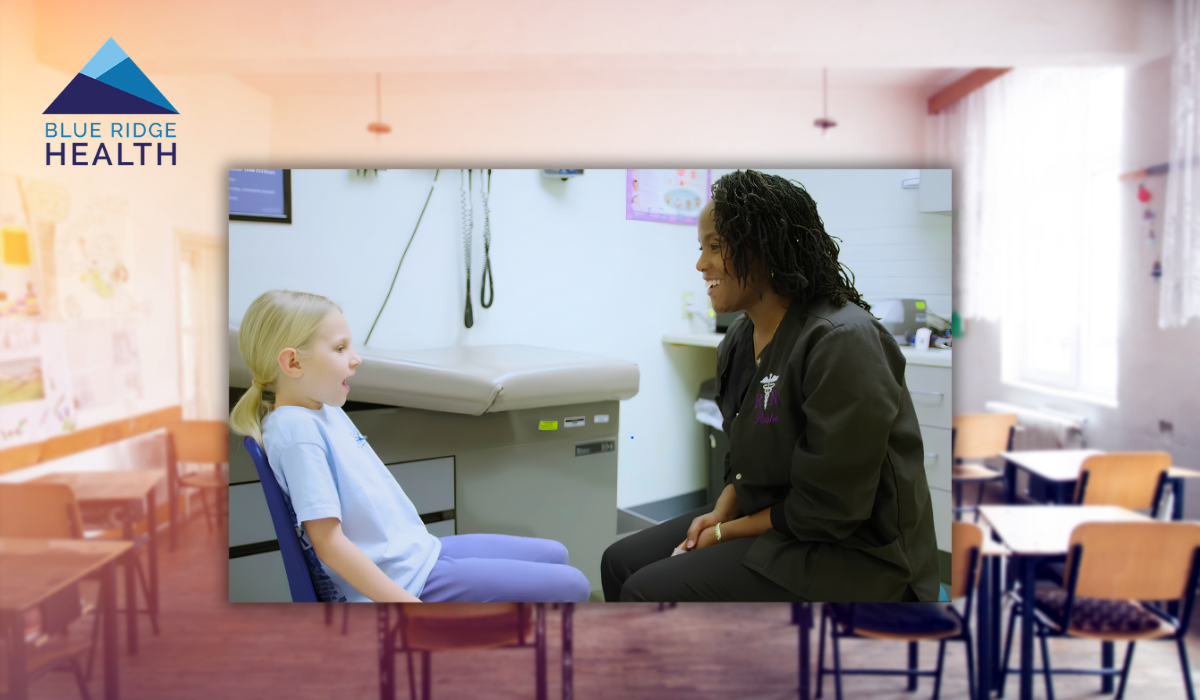
So Much More Than the School Health Clinic
For a child, being healthy and being ready to learn are closely connected. A sore throat, uncontrolled asthma, anxiety or another health concern can mean missed class, missed work for a parent, and sometimes care that gets delayed because getting to an appointment simply isn’t easy.
Blue Ridge Health’s School-Based Health program helps change that equation by bringing healthcare to a place children already spend much of their day. In 2025 alone, 29,201 children were served through BRH School-Based Health Centers, helping students get care sooner, families overcome barriers to access, and children spend more time where they belong, in the classroom.
And what happens there goes far beyond the traditional image of the school nurse.
Depending on the location, students can receive primary and urgent care, well-child visits, health screenings and physicals, management of chronic conditions such as asthma and diabetes, behavioral health services and nutrition support. Care is available to families regardless of their ability to pay, and BRH accepts private and public insurance.
The impact reaches beyond convenience. School attendance and student success are closely connected, and having healthcare available on or near campus can help students get the care they need sooner while reducing time away from the classroom. It can also mean a parent does not have to leave work and transport a child across town, or sometimes much farther, for an appointment.
Behavioral health has become an especially important part of that care. BRH counselors work with students experiencing anxiety, depression, major life changes, Attention-Deficit/Hyperactivity Disorder and other challenges. Support can include assessment, individual, family and group counseling, referrals, medication management when appropriate, and coordination with parents, healthcare providers and school support teams.
For families, that access can be particularly valuable at the beginning of a new school year, when changing routines, expectations and relationships can bring new physical and emotional needs to the surface. But the value continues throughout the year. Parents remain part of their child’s care, while students have a trusted place to turn when they need help.
And the impact does not necessarily stop with the student. School-based providers can also connect with school staff and families, extending the reach of healthcare into the larger school community.
Blue Ridge Health launched School-Based Health in 1994. In the years since, both its reach and the range of care available through schools have grown substantially. What has remained constant is the idea behind it: remove barriers by bringing high-quality healthcare closer to the children and families who need it.
Because when children can get the care they need without unnecessarily leaving school, the result can be so much more than a healthcare visit. It can mean more time in the classroom, less disruption for families and better support for a child’s health today and in the years ahead.